Sunday, October 14, 2012

Oh, No!


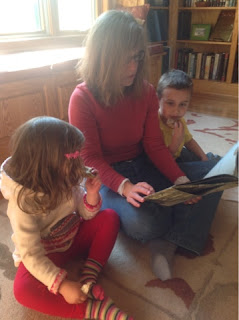
Reading a new book while eating a warm chocolate chip cookie (after kicking a soccer ball in the leaves) is the perfect way to spend a fall afternoon according to "the kids" (my cherished neighbor children). Candace Fleming's latest picture book Oh, No! (illustrated with fabulous relief prints by Eric Rohmann) just came in on reserve, and they were engrossed from the first "Ribbit-oops!" uttered by Frog as he fell into the deep, deep hole. They tracked the tiger as Mouse (Pippa-eeek!), Loris (Soo-slooow!), Sun Bear (Grab on!), and Monkey (Wheee-haaaa!) all ended up in the hole (Oh, no!) and loved when the earth shook (Ba-boom!) as a jungle creature came to their rescue. They immediately wanted to re-read it. This time, when we got to the bumble-rumble of the ground, my two-year-old friend said, "Here's where the elephant arrives!"

Wednesday, October 10, 2012

By Any Other Name


Philip Stead's A Home for Bird is the read-aloud book for primary children this week. The story begins with a heavily-loaded green truck scooting down a road - and a drawn-out "Cuckooooooooooo" sounding in the truck's wake. As Vernon (a frog) attempts to help Bird find home, Bird remains silent and compliant. Observant readers notice that the green truck later pulls up in front of a home...the same home where Vernon and Bird go at the end of a long journey. They got there with help from a kind stranger who pointed the way. When I ask about that stranger, all the kids know what it is, its function, and that it usually has N, E, S, and W on it, but their words for it never quite get to the real term: a weather vane.

They suggested it was a wind pointer, a direction giver, a wind mill, a cupola (Wow!), a rooster, a chicken, a wind direction.

Tuesday, October 9, 2012

Cat Tale


Michael Hall is a master of ideas and creativity. His previous two picture books - Perfect Square (2011) and My Heart is Like a Zoo (2009) - have prompted such ingenious writing and artwork by students in our school. His latest book Cat Tale is filling young readers with word wonder. Three cats named Lillian, Tilly, and William J. move through the story with homophones and homonyms that make a delightful puzzle. From chews and choose to ewes and use, there are word pairs that craftily combine unlikely activities and objects. The cats steer a plane and then plane a board. They board a train and then train some ducks to duck a shoe (having previously needed to shoo fleas). The children's smiles of recognition and hands shooting in the air made obvious their engagement with every page until the cats fixed all the jumbled words. They all want to cut boxes and shapes to make art like Michael's.

Monday, October 8, 2012

The Frank Show


Last week we read aloud a new picture book by David Mackintosh to the intermediate grade students called The Frank Show. First, though, we read it together at the bookshop, laughing and remembers others in our lives whose thoughts and sayings were brought to the forefront by the things Frank says in the book:

  • "Things were a lot tougher back then."
  • "You could hear yourself think!"
  • "These days there are too many gadgets and gizmos. I prefer doing things the old-fashioned way."
  • "If it ain't broke, don't fix it."
  • "They don't make 'em like that anymore."
  • "Today's music is just noise, and you can't understand the words."
The students were mesmerized by the story (and the quirky illustrations) of a boy who must talk for one minute about one person. For various reasons, he chooses his grandpa Frank, even though Frank is just a grandpa and does not seem to have a lot of the interesting qualities and talents possessed by his classmates' chosen people. After the narrator tells about all the things Frank does not like, he is at a loss for words. Then Frank tells the children about his stint in the war, and the children in the book are also mesmerized. Frank is obviously the coolest person of all.

The resulting discussion revealed some fascinating family histories and generated questions the children would love to ask their family members. They also loved learning that my grandpa was in the Navy (like many of their grandpas and great grandpas) and was a cement truck driver.

Sunday, October 7, 2012

Stop, Drop, Roll


In preparation for an upcoming fire drill, second graders and I discussed the exit route from the library, being quiet as we walked to our safe spot and waited for the all-clear signal, and why we practiced for a potential fire.

One student then volunteered, "I know what to do if your clothes catch on fire."

"What is that?" I asked her.

"Stop, drop, and roll," she told us.

"I learned that, too," I replied. "I learned it in a book called Clifford the Firehouse Dog."

She immediately pointed at me and exclaimed, "Same book! Me, too!"

I love connections like these with readers and books!

Wednesday, October 3, 2012

Fulmar


Today I finished Thomas Rockwell's How to Eat Fried Worms with one fourth grade group. For those who do not remember the end of the story, Billy's mom (he is the boy who agreed to eat 15 worms in 15 days) receives a letter from Dr. McGrath, their family physician, telling her of the recent dangers he has discovered about the consumption of worms. Using rather extravagant language, the "doctor" warns her to stop Billy from eating any worms until he returns in two days.

One student exclaimed, "Why wouldn't he just call her if it was that important?"

Another started chuckling. I asked what he found amusing, and he said, "Fulmar."

"You know about fulmar?" I asked.

"Yes. It is a seabird" he told me.

"However did you know about them?" "They were in a book I read called That's Disgusting. They have incredibly oily bodies."

The depth of wide-reading and background knowledge cannot be underestimated.

Monday, October 1, 2012

Comparative Literature


I have loved Bedtime for Frances for a long time. As a young girl, I spent many hours at the table, forced to eat the rest of the beef roast or pork roast on my plate. I wished for foods I liked. Like Frances, I often thought other people's lunches were better than my own. Now that I read it through adult eyes and experiences, I note, of course, the masterful way the Hobans taught a lesson without being didactic.

This summer, while visiting with Cyndy Szekeres, she noted that the first Frances book was not illustrated by Lillian Hoban but by Garth Williams, a shared hero in the world of illustration. I could hardly believe that was true! Though I trust Cyndy, I looked up the information and confirmed her words - then ordered a copy for my personal library.

I would love to do a comparative literature study with children involving these two books. Frances is the same character in her actions and words in each, but she is a softer, more defined badger, somehow, in the Williams' interpretation, and it is not just because she may have had a pre-bedtime bath. Her features are clearer. What would the children say? I am hesitant to discover. You see, while her parents may just give her bread and jam to convince her to eat more broadly, they threaten spankings in order to get her to bed. I do not desire to engage in the discussions that might occur on the story steps about that topic.